
.webp)
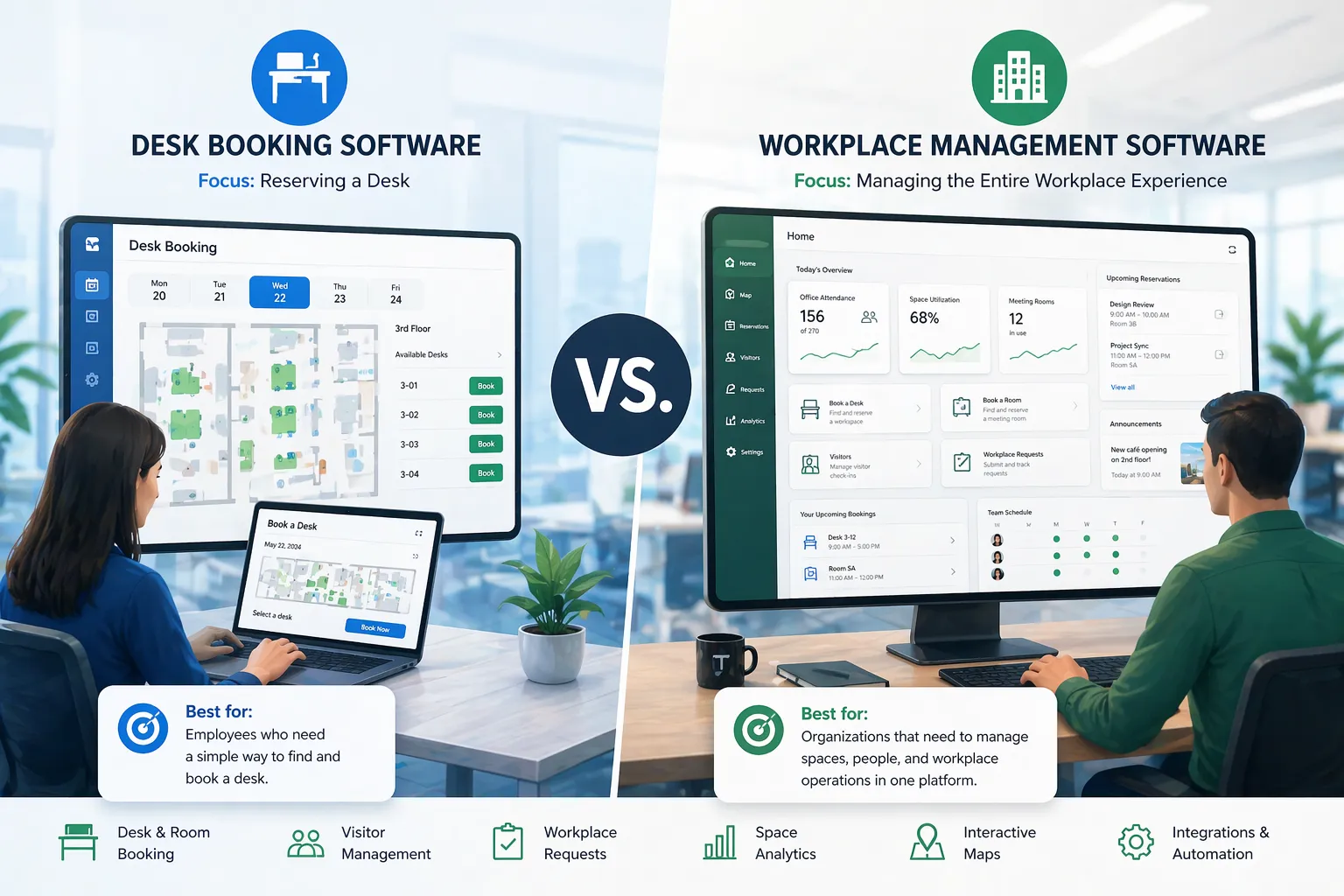
Many companies start searching for desk booking software.
But during the buying process, they often encounter a broader category:
Workplace management software.
That leads to a common question:
What is the difference between desk booking software and workplace management software?
The short answer:
Desk booking software is typically a point solution focused on reserving desks. Workplace management software is a broader platform that includes desk booking, but also supports meeting rooms, visitor management, workplace requests, analytics, and workplace coordination.
That distinction matters.
Because many companies start by solving one problem — desk reservations — and later realize they need much more.
Desk booking software helps employees reserve desks or workspaces when they come into the office.
Typical capabilities include:
Its primary purpose is straightforward:
Help employees find and reserve a workspace.
For some organizations, that may be enough.
Workplace management software includes desk booking, but extends much further.
It helps companies manage how people, spaces, visitors, and workplace services operate together.
It often includes:
Rather than solving one scheduling problem, workplace management software helps support workplace operations more broadly.
The simplest way to think about it:
Desk booking software helps employees reserve desks.
Workplace management software helps organizations manage the workplace.
That is a much bigger scope.
CapabilityDesk Booking SoftwareWorkplace Management SoftwareDesk reservationsYesYesInteractive mapsOftenYesMeeting room bookingSometimesYesVisitor managementRarelyYesWorkplace requestsNoYesUtilization analyticsBasicAdvancedTeam coordinationLimitedYesPolicy automationLimitedYesMulti-workflow supportNoYes
This is where many buyers realize they may be evaluating two very different categories.
Desk booking software can make sense if:
In these cases, a point solution may work.
Organizations often move toward a broader platform when they need to support:
Managing desks, rooms, visitors, and requests in separate systems often creates friction.
Consolidation becomes attractive.
Employees generally do not want separate tools for:
They want one experience.
Point solutions can create fragmented data.
A broader platform can provide better insights into:
That matters for planning.
Many organizations outgrow standalone tools.
What begins as desk booking often expands into a broader workplace program.
This happens often.
A company buys desk booking software.
Then asks:
Can it manage meeting rooms?
Can it handle visitors?
Can it support workplace requests?
Can it provide utilization reporting?
Can it integrate with Teams?
At that point, they may realize they were really looking for workplace management software all along.
Not necessarily.
This is another common point of confusion.
Traditional IWMS platforms often focus heavily on:
Modern workplace management software is often more focused on:
They can overlap.
But they are not always the same category.
Neither is universally better.
It depends on what problem you are solving.
If you only need desk reservations, desk booking software may be sufficient.
If you need a platform to support how your workplace operates, workplace management software may be the better fit.
The question is not which is better.
It is which problem you actually need to solve.
When evaluating vendors, ask:
Is this a point solution or a broader platform?
What workflows does it support beyond desks?
Can it support meeting rooms and visitors?
What reporting and utilization insights does it provide?
Can it support us as our needs grow?
Those questions tend to surface important differences quickly.
Desk booking software is typically designed to help employees reserve desks.
Workplace management software includes desk booking, but also supports broader workplace operations like rooms, visitors, requests, analytics, and coordination.
That is the core difference.
And for many companies, understanding that distinction changes what they buy.
No. Desk booking software is typically a narrower category. Workplace management software generally includes desk booking plus broader workplace functionality.
It depends on whether you only need desk reservations or need broader support for workplace operations.
Not always. There can be overlap, but they are often different categories.
The best option depends on your workflows, integrations, and whether you need a point solution or broader platform.

A workplace experience platform that brings your hybrid team together.