


If you're evaluating workplace platforms for a 500+ employee tech company, you're likely facing three pressures simultaneously: reducing real estate costs, improving space utilization analytics, and maintaining employee satisfaction in a hybrid model. The platform you choose will either become invisible infrastructure that employees love—or a friction point that IT and People Ops manually prop up every week.
This comparison focuses on the operational reality: Which platform requires the least administrative maintenance while delivering measurable ROI on your commercial lease?
Envoy built its reputation on lobby iPad check-ins. Over the past five years, they've expanded into desks, deliveries, and rooms but the architecture shows. Each module feels bolted on because it was. For organizations prioritizing a polished guest experience at reception, Envoy delivers. For companies focused on employee experience and space optimization, the cracks appear quickly.
Core Limitation: Workflows don't talk to each other. Your desk booking system doesn't inform your room booking system. Visitor data doesn't trigger space utilization reports. You're managing multiple products under one login, not one platform.
This fragmentation has real costs. Research shows that 70% of employees spend upwards of 20 hours per week chasing information across different systems; that's half a work week lost to mundane tasks.
Robin earned market share by solving conference room chaos, and they solved it well. Their hardware integrations (room panels, sensors) remain best-in-class for meeting space compliance. But Robin's strength is also its constraint: the platform thinks in rooms, not people.
Core Limitation: Robin requires manual configuration for nearly every workplace policy. Want to suggest desks near a colleague's booking? You'll need a workaround. Need to auto-release unused reservations? You're setting rules in a dashboard, not leveraging AI. For facilities teams comfortable with hands-on administration, Robin works. For lean operations teams, it's a time sink.
Tactic entered the market in 2020 with a different thesis: workplace software should feel like consumer software, and it should reduce administrative work, not create it. Instead of retrofitting legacy single-point solutions into desk booking, Tactic designed a unified platform where Tessa AI handles the repetitive decisions that bog down Envoy and Robin users.
Core Advantage: Frictionless employee experience powered by automation. Tessa AI learns team patterns, makes suggestions, auto-releases no-show bookings, and proactively surfaces space utilization insights to teams.
But the real ROI isn't just operational—it's behavioral. When workplace software is this intuitive and cohesive, it becomes an actual driver of office attendance: employees choose to come in because Tactic makes coordination effortless (one tap to sit near your team), not because HR mandated it. Companies that have migrated to Tactic have seen a 78% increase in organic office attendance after just 90 days.
What Envoy Does Well:If your primary concern is front desk operations—contractor badges, NDA signing, host notifications—Envoy remains the gold standard. Their iPad-based check-in kiosks are polished, and integrations with security systems (Lenel, CCURE) are robust.
Where Envoy Falls Short for Mid-Market Tech:Envoy's desk booking and space management modules feel like afterthoughts because they were afterthoughts. The mobile app prioritizes visitor workflows, meaning employees often find the desk booking feature buried three taps deep. There's no conversational interface. No AI assistance. Booking a desk requires manual floor plan navigation every time.
More critically: employees don't open Envoy unless they have to. It's software tied to compliance and gate access, not collaboration. According to Gartner (2025), while 82% of leaders report that governance-driven tools are necessary, 71% of employees view these mandated systems as "digital friction" that actively interrupts their workflow.
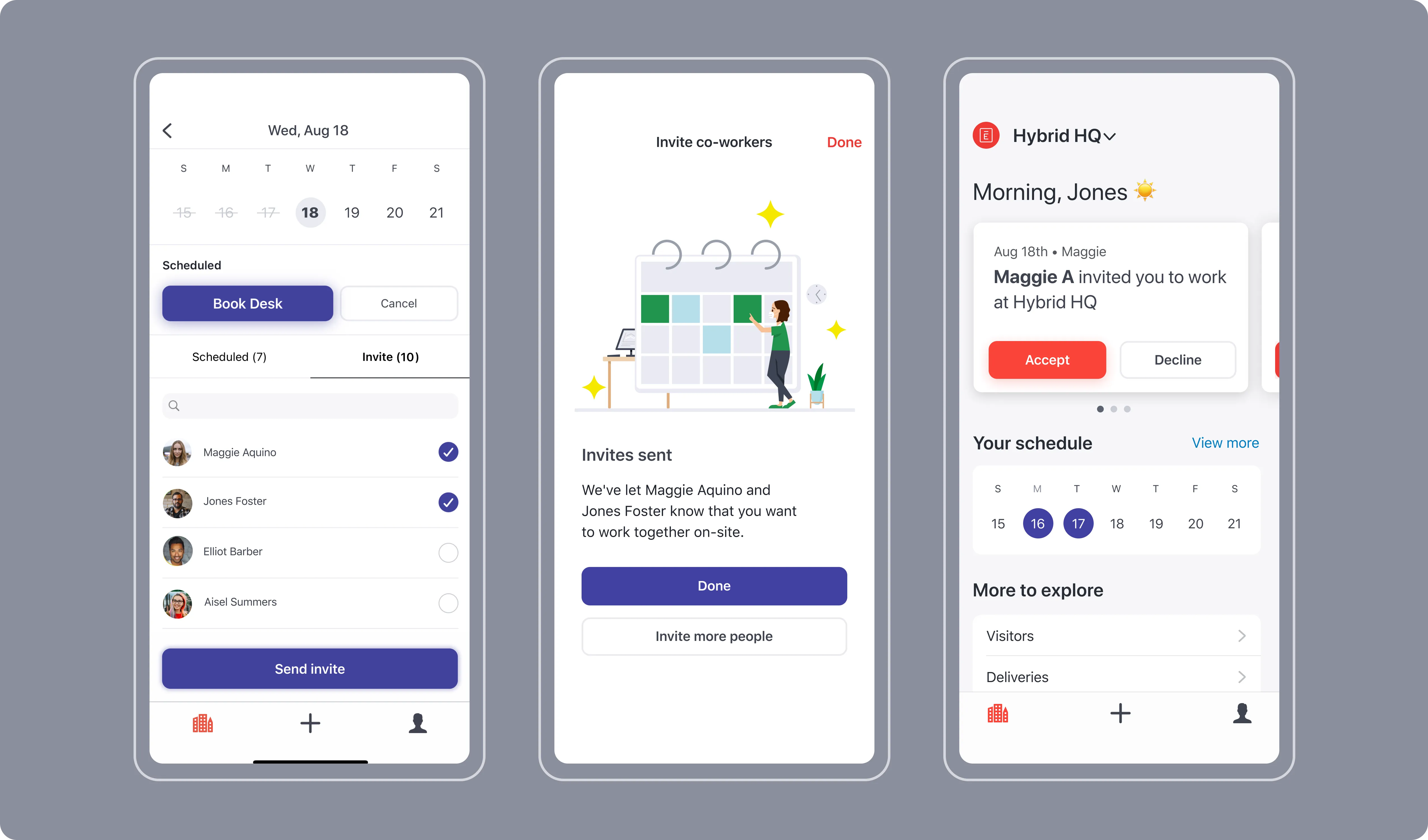
What Robin Does Well:Robin owns conference room analytics. If you need granular data on meeting room utilization, no-show rates, or optimal room sizes, Robin delivers. Their room display panels integrate seamlessly with Google Calendar and Outlook, and their reporting dashboards are built for real estate teams optimizing lease costs.
Where Robin Struggles in 2026:Robin's strength is also its limitation. The product architecture still centers on rooms, not people. Desk booking exists, but it feels like a separate product line. The mobile experience is analytics-heavy—great for facilities managers reviewing space utilization reports, less intuitive for employees who just want to find their teammate's desk.
Robin also lacks AI automation. Every booking is manual. Every schedule change requires human input. In a 500+ person hybrid environment where daily attendance fluctuates by 30-40%, this creates friction. Employees stop using the tool when it feels like extra work instead of a shortcut.
The Tactic Difference:Tactic wasn't retrofitted from a pre-COVID point solution. It was architected from the ground up to solve the hybrid workplace problem: How do you create an office environment employees choose to engage with, not comply with?
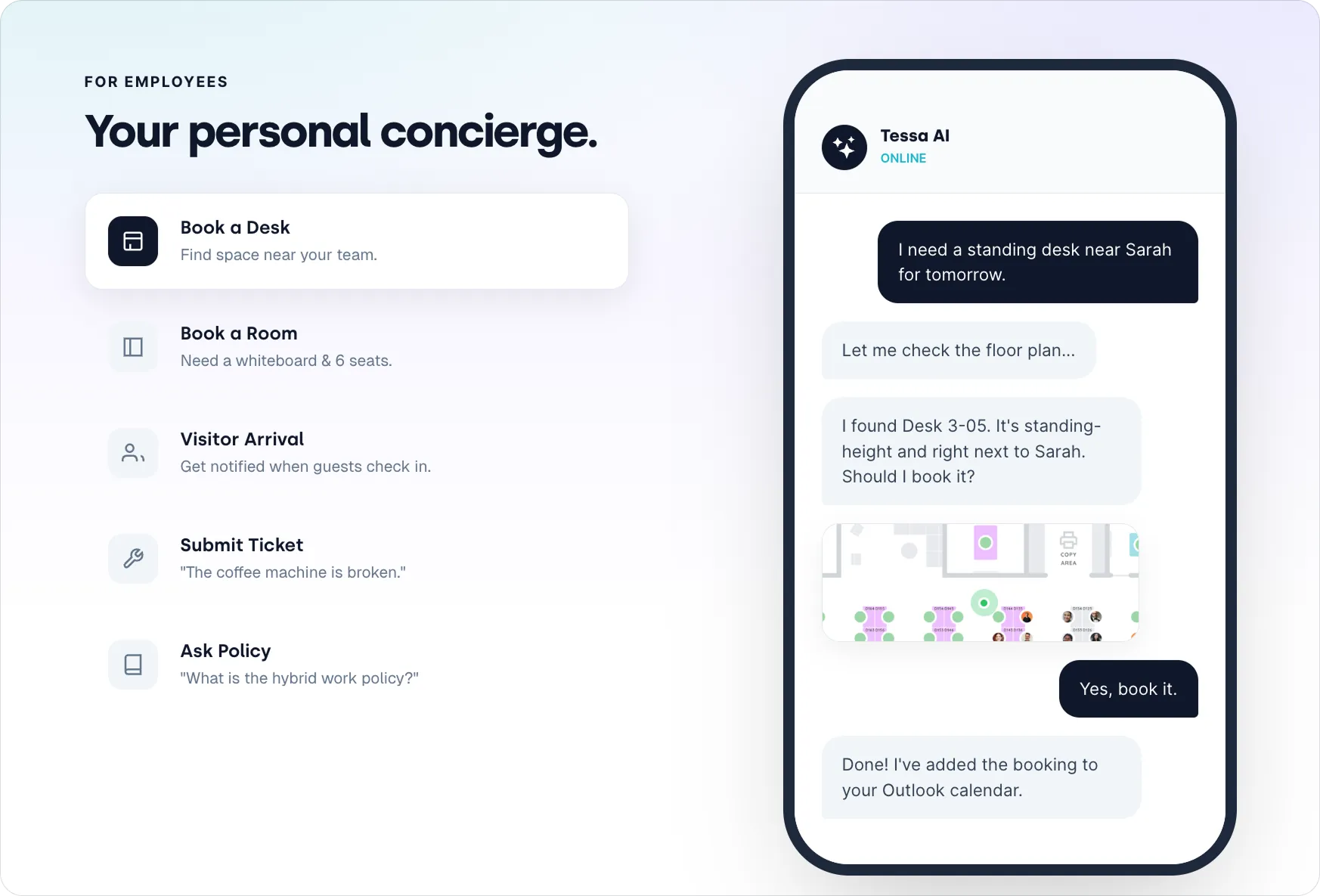
Tessa is Tactic's conversational AI assistant embedded across the platform. Instead of navigating floor plans or filtering dropdown menus, employees type or speak natural requests:
Tessa handles the search, suggests optimal options based on preferences and team proximity, and completes the booking. This isn't a chatbot gimmick but a fundamental rethinking of workplace software UX. Employees use Tactic because it saves them time, not because IT mandates it.
UX research consistently shows that when a workflow is perceived as long or complex, a significant share (up to 18%) of users abandon it. Our approach removes that friction by collapsing search + selection + booking into a single guided action.
Envoy and Robin both suffer from "feature seams"—the visible gaps where a visitor tool or room scheduler was expanded into adjacent functions. Tactic's codebase is unified. Desks, rooms, visitor management, and team presence all share the same UI patterns, the same mobile experience, the same search logic.
This matters for IT teams managing rollout. One SSO integration. One mobile app. One training session. Your employees don't experience workplace management as four different products duct-taped together.
The most overlooked metric in workspace software is voluntary engagement. Compliance tools get used when required. Experience tools get used proactively.
Tactic's home screen doesn't show you an empty floor plan. It shows you which teammates are in the office today, suggests desks near your project collaborators, and surfaces upcoming team events. The software is designed around the question: "Who should I work near today?" not "Which desk is available?"
This design philosophy drives adoption. When employees open Tactic to see their team's schedule, they organically book desks, reserve rooms, and coordinate in-office days—without facilities sending reminder emails.
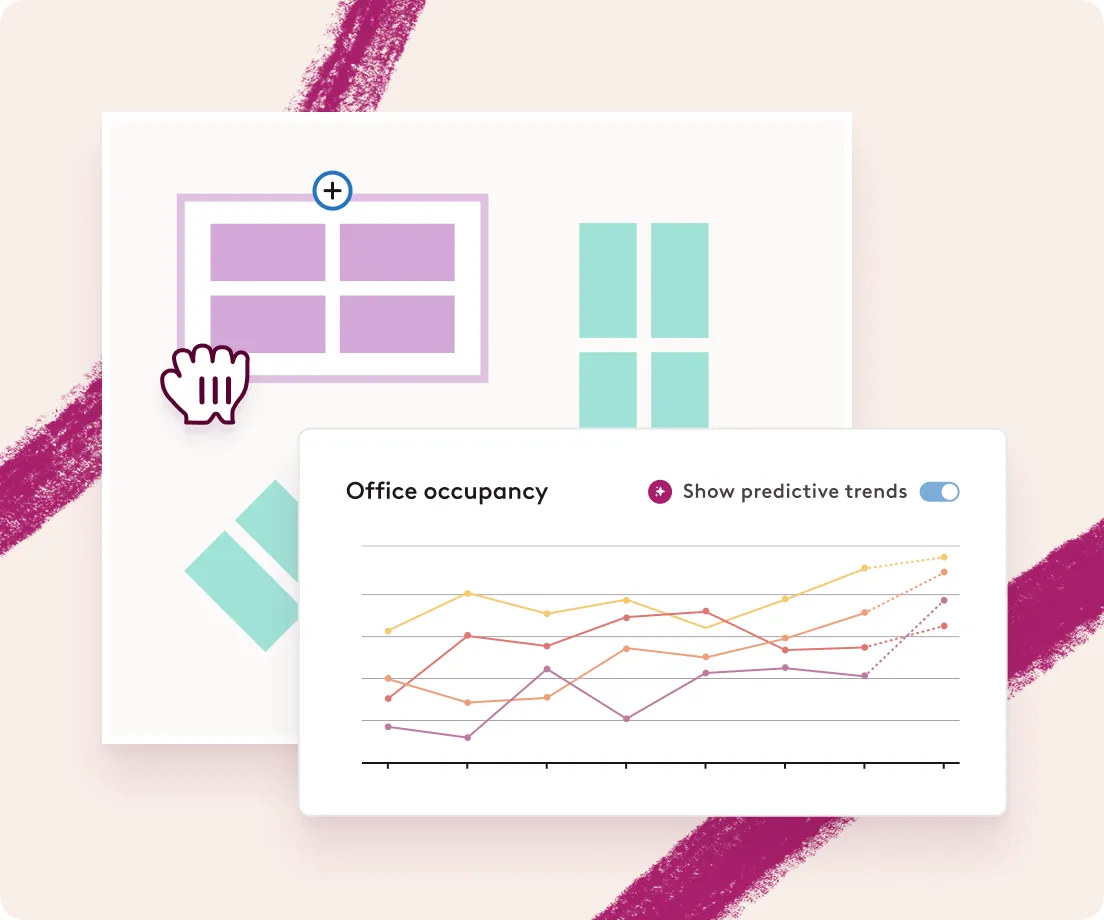
Fragmented tools create fragmented data. If your visitor log lives in Envoy, room bookings in Robin, and desk reservations in a Google Sheet, your real estate team lacks the unified occupancy metrics needed for lease optimization decisions.
Tactic provides a single source of truth: real-time employee presence data, predictive utilization modeling, and space allocation analytics across all booking types. This enables CFO-level conversations about footprint reduction, sublease opportunities, and workplace investment ROI with actual data, not stitched-together reports.
Mid-market tech companies care deeply about deployment speed and employee onboarding friction.
The change management advantage matters: The faster employees see value, the higher the adoption. Tactic's in-workflow design means employees start using the platform without formal training sessions.
Choose Envoy if:
Choose Robin if:
Choose Tactic if:
Generic demos don't answer the questions your CFO, Head of Real Estate, and VP of People Ops are actually asking. Tactic offers custom demo sessions where we map your current office policies, hybrid work patterns, and space constraints to the platform.
Request a Custom Demo at gettactic.com and we'll show you:
The difference between a workplace platform employees tolerate and one they actively use comes down to friction. Tactic removes it.

A workplace experience platform that brings your hybrid team together.