

Tactic News

Tactic Pricing & Features: Is it the Right Fit for Your Scale?

Reid Hiatt, CEO and Co-Founder of Tactic.
Reid Hiatt Jan 22, 2026
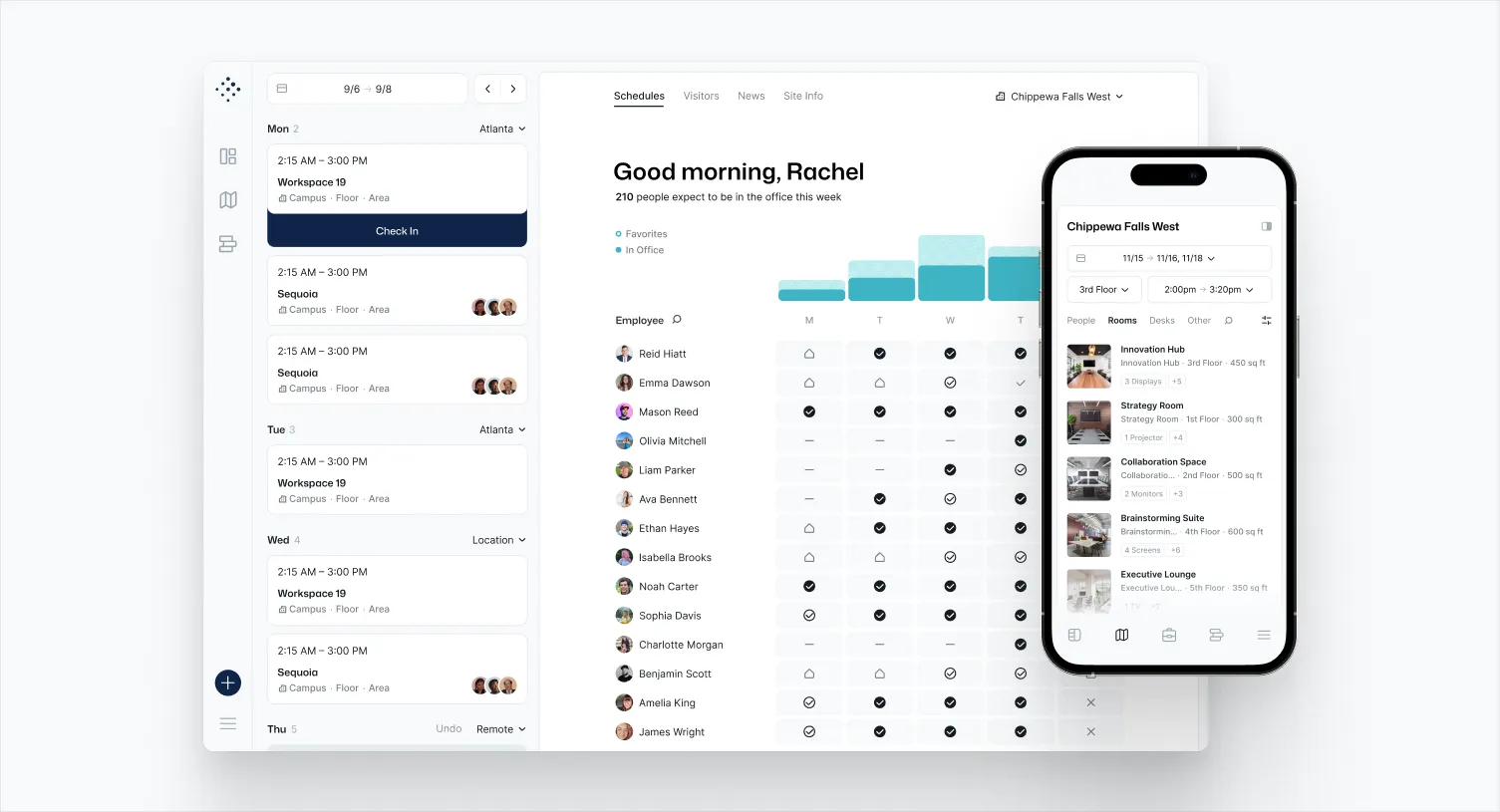
Tactic workplace management platform dashboard showing desk and room booking homepage on web and mobile.

Key Points

  • Pricing models: Per-user (all-inclusive) or per-resource (desks, rooms, parking); whichever fits your economics better
  • Sweet spot: Companies with at least 100+ employees or resources (desks and rooms); pricing floor makes Tactic uneconomical for smaller setups
  • Key differentiator: Flexible pricing that scales with your actual usage pattern, not arbitrary seat counts that penalize adoption

How Tactic's Pricing Works

Most workplace platforms force you into a per-user model that punishes engagement. Someone who books a desk once a month costs the same as your power user who reserves rooms daily. The result? Adoption stalls because employees hesitate to "waste" a booking on their company's dime.

Tactic solves this with two distinct pricing structures designed around how companies actually use workplace management software. This post breaks down both models, explains who benefits from each, and, more importantly, tells you when Tactic isn't the right fit.

Per-User Pricing: The All-You-Can-Eat Model

You pay per monthly active user, and everything is included: desk booking, meeting rooms, parking spots, visitor management, analytics—the entire platform.

The economic advantage: Adding office locations or resources doesn't change your bill. If you start with 200 users managing 150 desks across two offices, then expand to five offices with 400 desks, your cost only increases when you add more users, not when you add square footage.

This model works exceptionally well for distributed teams with hybrid policies. Your San Francisco employees might book desks 15 times per month while your Austin team comes in twice a week. The per-user model averages out these usage patterns without creating pricing friction that discourages low-frequency users from booking at all.

Per-Resource Pricing: The Precision Model

Here you pay based on physical resources: number of desks, meeting rooms, parking spaces, and visitor stations. Users are unlimited.

The economic advantage: For organizations with defined capacity and high user-to-resource ratios, this eliminates the "ghost user" problem. If you have 300 employees but only 150 desks (50% capacity planning), why pay for 300 seats when you're managing 150 resources?

This structure makes sense for companies with strict real estate optimization mandates. Your Finance team allocated budget for 200 desks across three floors. That's your cost basis, not fluctuating headcount or the 400-person email list that includes contractors, remote-only staff, and people on leave.

The pricing floor caveat: Tactic has a minimum contract value. If you're a 40-person startup with 25 desks, the economics are less likely to work. But for any company over 100 desks or users, the structure scales efficiently.

The Collaborative Pricing Process

Tactic's pricing is use-case driven. A financial services firm with 800 employees, 400 desks, 40 meeting rooms, and enterprise compliance requirements has radically different needs than a 150-person design studio with hot-desking and casual visitor flow.

During the sales process, expect a discovery session to map your office footprint, a model comparison showing per-user vs. per-resource economics, and an ROI projection based on your current real estate cost per square foot.

Security & Compliance: What's Included

Regardless of pricing tier, all customers receive:

  • SOC 2 Type II certification
  • Unlimited floor plan alterations
  • Tessa (Tactic’s native AI workplace assistant)
  • GDPR compliance with data residency controls
  • Role-based access control (RBAC) for IT, Facilities, and People Ops

The Anti-Sell: When Tactic Isn't Right for You

You're under 100 employees/resources: The pricing floor makes this uneconomical. Come back when you hit at least 100+.

You want software you can ignore: Tactic works best when Facilities and IT actively use the analytics to optimize space. The platform rewards engagement with data-driven lease optimization.

You operate in highly regulated industries with air-gapped requirements: Tactic is cloud-native. If you need on-premise deployment, we're not the fit.

Why Pricing Flexibility Drives Adoption

The hidden cost of rigid per-user pricing isn't the invoice; it's the behavioral tax on employees. When a workplace coordinator sees someone book a desk for one quarterly session and knows it costs the same as someone who's there daily, psychological friction emerges.

Tactic's per-resource model eliminates this completely. Employees don't think about cost per use. The per-user model solves a different problem: unpredictable resource expansion, creating budget certainty even as your real estate footprint scales.

The Tessa AI Advantage

Regardless of pricing structure, Tactic includes Tessa AI, our conversational booking engine. Employees interact through Slack, Teams, or mobile using natural language: "Book me a desk near the windows on Thursday." Tessa handles availability, confirms bookings, and sends reminders.

For Facilities teams, Tessa automates check-in reminders, no-show releases, and utilization reporting. This automation is why Tactic scales from 100 to 5,000+ employees without requiring Facilities headcount increases.

See Your Economics in Action

Schedule a custom demo where we'll map your actual floor plans, model both pricing structures, and show you real space utilization analytics from companies in your industry. You'll see your office in Tactic, not a sanitized demo, and we'll build an ROI projection based on your cost per square foot.

Book a custom demo and bring your Facilities lead, your IT director, and your hardest questions about scale, security, and fit.