.webp)
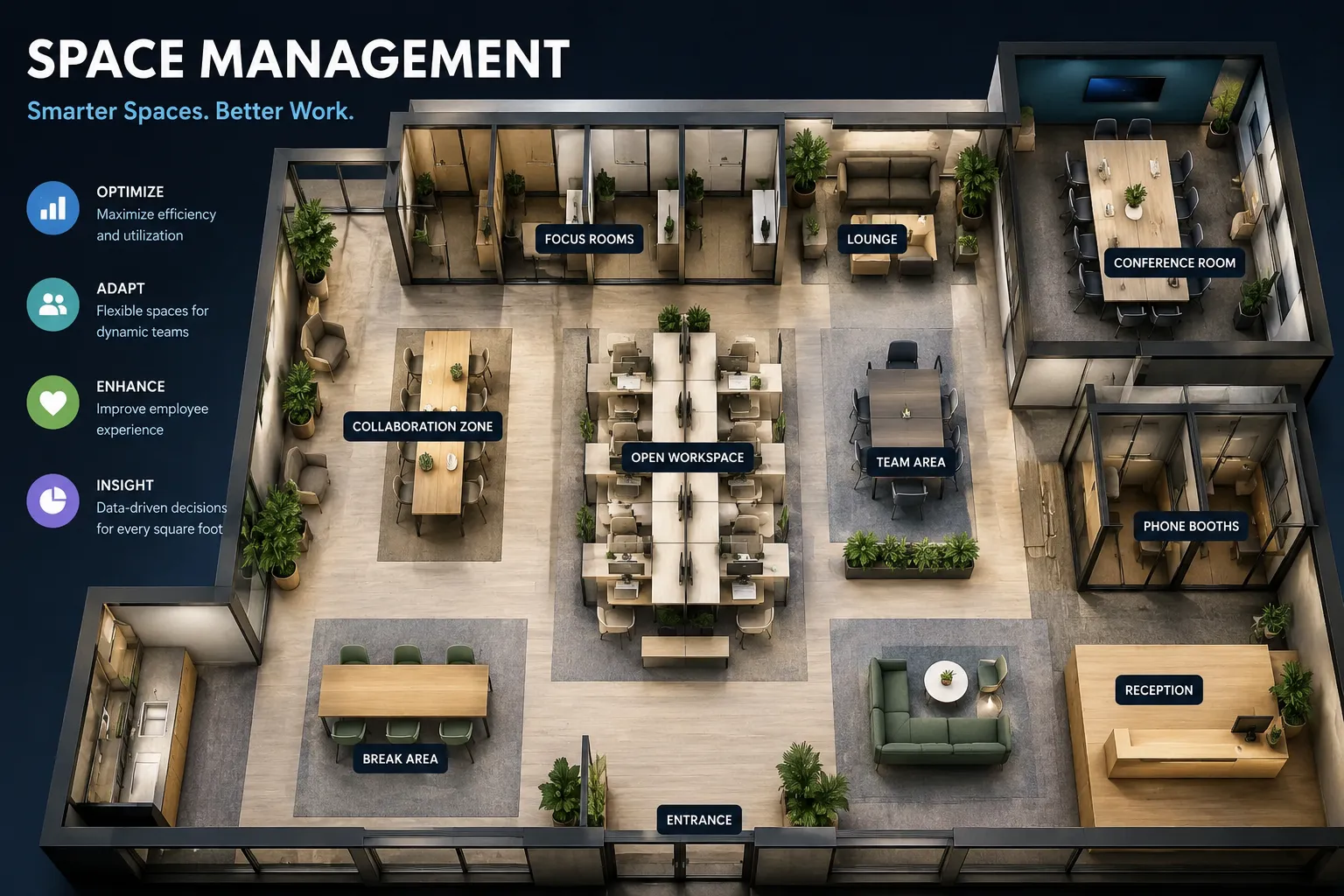
Enterprise teams often compare workplace management software and IWMS platforms when evaluating tools for space planning, hybrid work, and office operations.
The categories overlap, but they are not exactly the same.
The short answer: IWMS platforms are typically broader systems for real estate, facilities, maintenance, space planning, leases, and assets. Workplace management software is usually more focused on daily workplace operations and employee experience, including desk booking, room booking, visitors, workplace requests, maps, hybrid coordination, and utilization analytics.
Both can be valuable.
The right choice depends on whether the company is trying to manage a real estate and facilities portfolio, operate a better hybrid workplace, or both.
Workplace management software helps companies manage the day-to-day operations of the office.
It is often used by workplace, facilities, HR, IT, real estate, and employee experience teams.
Common features include:
The focus is usually practical and operational:
How do employees use the office?
How do teams find space?
How do workplace teams manage requests?
How do leaders understand utilization?
IWMS stands for Integrated Workplace Management System.
An IWMS is typically a broader enterprise software category for managing real estate, facilities, maintenance, space, assets, leases, and capital projects.
Common IWMS capabilities may include:
IWMS platforms are often used by large organizations with complex facilities and real estate portfolios.
Workplace management software and IWMS platforms can both support space planning and workplace operations.
Both may help companies understand:
The difference is usually emphasis.
IWMS often starts from the real estate and facilities management perspective.
Workplace management software often starts from the employee experience and workplace operations perspective.
A simple way to think about it is this:
IWMS helps companies manage the real estate and facilities portfolio.
Workplace management software helps companies manage how employees use the workplace every day.
That means IWMS may be better for lease data, facilities maintenance, assets, and portfolio planning.
Workplace management software may be better for desk booking, room booking, visitor workflows, interactive maps, requests, and hybrid employee coordination.
Employees may use workplace management software directly to:
Because employees use it, the experience needs to be simple and intuitive.
If the platform is too complicated, adoption suffers.
That is one of the biggest differences from traditional enterprise systems.
IWMS platforms are often built for teams managing complex operational backends.
That may include:
These users may need deeper back-office capabilities, reporting, and governance.
That can be valuable, but it may not always translate into a simple employee experience.
Workplace management software often focuses on:
IWMS often focuses on:
There is overlap, but the center of gravity is different.
Workplace management software may be the better fit when your company needs to:
If employees are expected to use the system regularly, workplace management software may be the more practical choice.
An IWMS may be the better fit when your company needs to manage:
IWMS platforms can be valuable for organizations with complex real estate and facilities needs.
But they may be more than what a company needs if the main priority is hybrid workplace operations.
Yes.
Some enterprise companies use an IWMS for real estate and facilities portfolio management and a workplace management platform for employee-facing office operations.
For example:
The key is making sure the systems have clear roles and do not create unnecessary complexity.
Hybrid work has changed how companies think about workplace software.
It is no longer enough to know how much space a company has.
Workplace teams also need to know how that space is actually being used.
They need to understand:
That is why workplace management software has become a critical category.
It connects planning with daily usage.
Tactic is designed for modern workplace management.
It supports:
Tactic is a fit for companies that need enterprise-ready workplace operations without forcing employees into a complicated legacy system.
It helps companies manage how the workplace is planned, used, and improved.
Workplace management software and IWMS platforms overlap, but they are not the same.
IWMS platforms are often broader and more focused on real estate, facilities, leases, assets, maintenance, and portfolio management.
Workplace management software is more focused on daily office operations, employee experience, hybrid work, desk booking, room booking, visitors, requests, maps, and utilization analytics.
For companies focused on building a better hybrid workplace, workplace management software may be the better fit.
For companies with complex real estate and facilities management needs, an IWMS may also be necessary.
IWMS platforms are usually broader systems for real estate, facilities, maintenance, assets, leases, and portfolio planning. Workplace management software focuses more on daily workplace operations, employee experience, desks, rooms, visitors, requests, maps, and hybrid work.
IWMS stands for Integrated Workplace Management System.
Not exactly. Facilities management software often focuses on maintenance, assets, and facilities operations. Workplace management software often focuses on employee-facing workplace workflows like desks, rooms, visitors, requests, maps, and utilization.
Sometimes, depending on the company’s needs. If the main priority is hybrid workplace operations, workplace management software may be enough. If the company needs deep lease, asset, maintenance, and portfolio management, an IWMS may still be useful.
Tactic is workplace management software. It supports desk booking, room booking, interactive maps, visitor management, workplace requests, move requests, space planning, and utilization analytics.

One platform for your entire workplace.