
.webp)
Space planning has changed.
For years, companies looked at space planning software as a tool for managing floor plans, seating assignments, occupancy data, and office moves.
But hybrid work has made the workplace more dynamic.
Employees are not always in the office. Teams need flexible seating. Meeting rooms need to sync with calendars. Workplace teams need to handle requests, moves, visitors, and space changes without relying on spreadsheets or disconnected tools.
That is why many companies looking for a SpaceIQ alternative are not just looking for another space planning system.
They are looking for a modern workplace management platform.
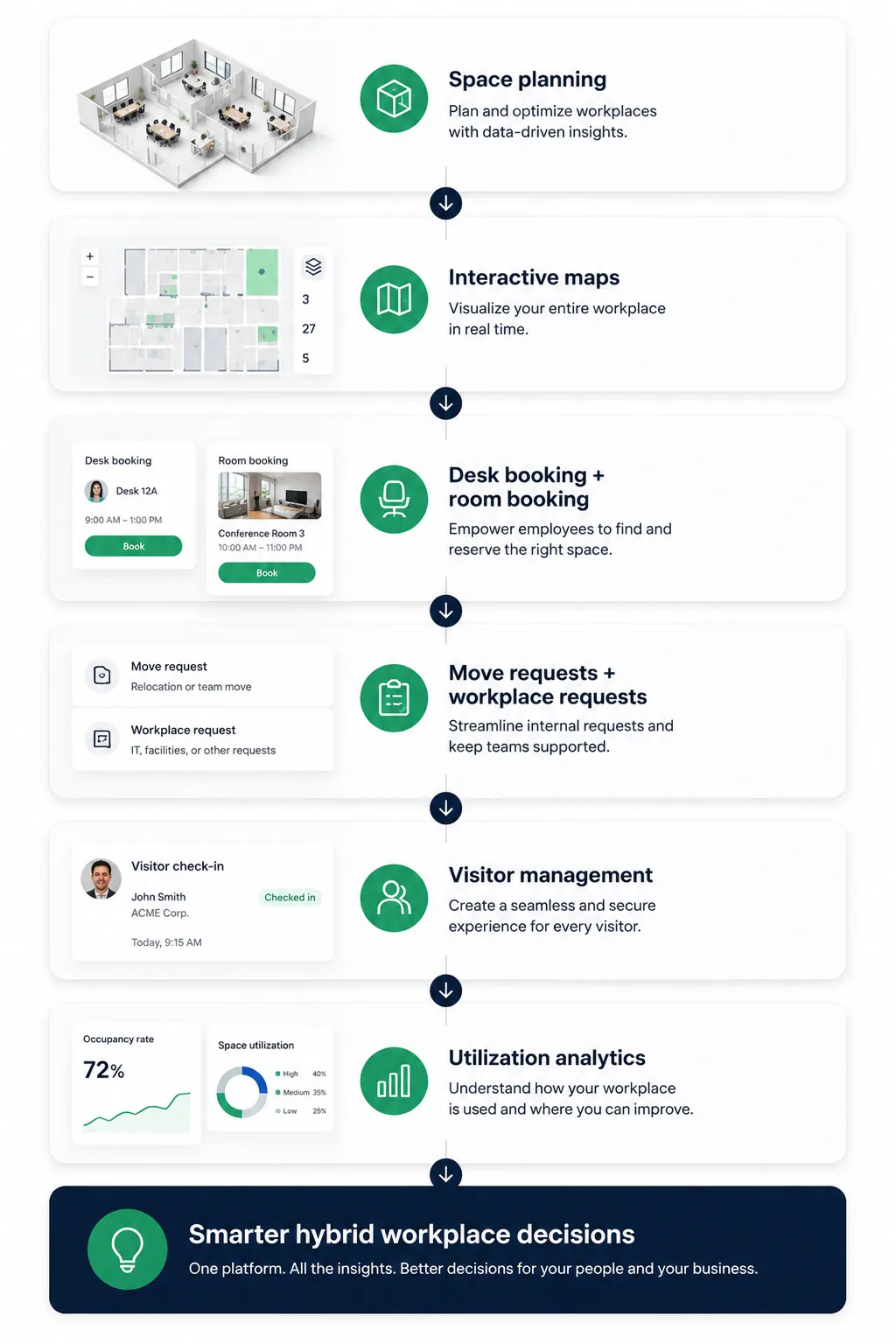
The short answer: The best SpaceIQ alternative should help companies manage space planning, interactive office maps, desk booking, room booking, move requests, workplace requests, visitor management, utilization analytics, and hybrid workplace operations in one connected platform.
For companies that want a modern, employee-friendly workplace experience, Tactic is built to support more than static floor plans.
It helps teams actually run the hybrid workplace.
SpaceIQ is known as a space planning and workplace management solution historically used by companies to manage office floor plans, seating, occupancy, and workplace data.
It is now part of Eptura, a broader worktech platform that includes workplace, asset, and facility management tools.
For some enterprise organizations, that broader ecosystem may be a fit.
But companies looking for a simpler, modern, employee-friendly platform may want an alternative that is easier to adopt and built around today’s hybrid workplace workflows.
Companies may evaluate alternatives to SpaceIQ for several reasons.
Some want a more modern employee experience.
Some want easier desk and room booking.
Some want workplace requests and move requests in the same platform.
Some want maps that employees actually use.
Some want a solution that feels less like a traditional IWMS and more like a modern workplace operating system.
Common reasons include:
The right alternative depends on what problem the company is really trying to solve.
Traditional space planning often focused on questions like:
Those questions still matter.
But modern workplace teams now need to answer more dynamic questions:
That requires more than a static planning tool.
It requires a platform that connects planning with day-to-day workplace activity.
A modern workplace platform should make office maps useful for both admins and employees.
Employees should be able to use maps to:
Admins should be able to use maps to:
Maps should not only be for facilities teams.
They should be part of the everyday workplace experience.
Hybrid offices need flexible desk booking.
Employees should be able to reserve desks based on:
This helps companies manage fewer desks than employees without creating confusion.
Desk booking also gives workplace teams data about how desks are actually used.
That data is critical for space planning and portfolio decisions.
Meeting rooms are one of the most important parts of the workplace experience.
A strong SpaceIQ alternative should support room booking that works with tools employees already use.
That includes:
Room booking should not feel disconnected from the rest of the workplace.
If employees can book desks, reserve rooms, and invite visitors from the same platform, the workplace becomes easier to manage.
Move management is a major part of space planning.
Teams change. Departments grow. Employees move floors. Offices get reconfigured.
A modern platform should help companies manage move requests without relying on email threads or spreadsheets.
Move request workflows can support:
This helps workplace teams manage change more efficiently.
Space planning is not the only operational need in the office.
Employees also need a simple way to submit workplace requests.
These may include:
A workplace request system helps teams track, assign, and resolve these issues.
Instead of scattered Slack messages or emails, everything can be managed in one workflow.
This is especially important for enterprise companies with multiple offices, floors, and support teams.
Many companies evaluating space planning tools also need visitor management.
A modern workplace platform should support guest workflows such as:
Visitor management connects naturally to room booking and workplace operations.
For example, if a visitor is coming in for a meeting, the company may need a room, a host notification, a visitor badge, and a check-in record.
Those workflows should work together.
Space planning decisions should be based on real data.
A strong platform should help companies understand:
This helps companies make better decisions about office space, seating, rooms, and resources.
Without utilization data, space planning becomes guesswork.
Enterprise companies need more than a simple booking tool.
They need a platform that can support:
A strong SpaceIQ alternative should support enterprise requirements while still being simple enough for employees to use.
Enterprise workplace teams need more than a simple desk booking tool.
They need a platform that can support multiple offices, complex teams, security requirements, integrations, and operational workflows across the entire workplace.
Tactic is built to support enterprise companies with:
For enterprise organizations, the challenge is not just planning office space.
It is operating a workplace that employees can actually use.
That is where Tactic fits.
SpaceIQ has historically been associated with space planning, occupancy, and workplace analytics.
Tactic is built around a more connected hybrid workplace experience.
That means Tactic can support space planning while also helping employees and workplace teams manage the day-to-day workflows that make offices work.
Here is the simplest distinction:
Traditional space planning software helps companies understand and plan office space.
Modern workplace management software helps companies plan, operate, and experience the workplace.
Tactic is designed for companies that need both.
Traditional space planning tools are often focused on:
Modern workplace management platforms are built for:
For companies managing hybrid work, the second category is becoming increasingly important.
Tactic helps companies manage the workplace across multiple connected workflows.
That includes:
This makes Tactic a strong option for companies that want a modern alternative to traditional space planning tools.
Tactic may be a better fit if your company wants:
If your goal is only deep real estate portfolio management or asset-heavy IWMS functionality, a larger IWMS platform may still make sense.
But if your goal is to manage the modern hybrid workplace, Tactic may be a better fit.
Before choosing a SpaceIQ alternative, enterprise buyers should ask:
The best platform should support both the workplace team and the employee experience.
The best SpaceIQ alternative depends on what your company needs.
If you only need traditional space planning, a space planning or IWMS tool may be enough.
But if you need to support hybrid work, flexible seating, meeting room booking, workplace requests, move requests, visitor management, interactive maps, and utilization analytics, a modern workplace management platform is likely a better fit.
Tactic is built for companies that want to connect space planning with the daily workflows employees and workplace teams actually use.
It helps enterprise organizations manage the modern workplace, not just plan it.
The best SpaceIQ alternative depends on your needs. Companies focused on hybrid workplace management, desk booking, room booking, workplace requests, move requests, maps, and visitor management may consider Tactic as a modern alternative.
Yes. SpaceIQ is now part of Eptura, a broader worktech platform.
Companies should look for interactive maps, desk booking, room booking, space planning, move requests, workplace requests, visitor management, utilization analytics, and enterprise-ready integrations.
Yes. Tactic can be considered a SpaceIQ alternative for companies that want modern workplace management, hybrid office tools, desk and room booking, maps, requests, and analytics.
Space planning software focuses on planning and managing physical office space. Workplace management software includes space planning but also supports daily workplace workflows like desk booking, room booking, visitor management, workplace requests, and hybrid coordination.

A workplace experience platform that brings your hybrid team together.